


The conversations around Declan Rice’s “performative scanning” have been put to bed by football experts, Be Your Best.
In recent months, following Arsenal’s success and his performances for England, there have been discussions around Rice’s “performative scanning,” the idea that players can sometimes appear to scan the pitch without necessarily using the information to influence what they do next.
But when Oslo-based football technology experts, Be Your Best, analysed Rice’s recent performances against Sunderland, a 2-0 win, and Brighton, a 3-0 defeat, the data told a different story.
The main takeaway was that Rice’s scanning appeared deliberate and calculated, with the midfielder consistently gathering information before receiving the ball and using that information to influence his next action.
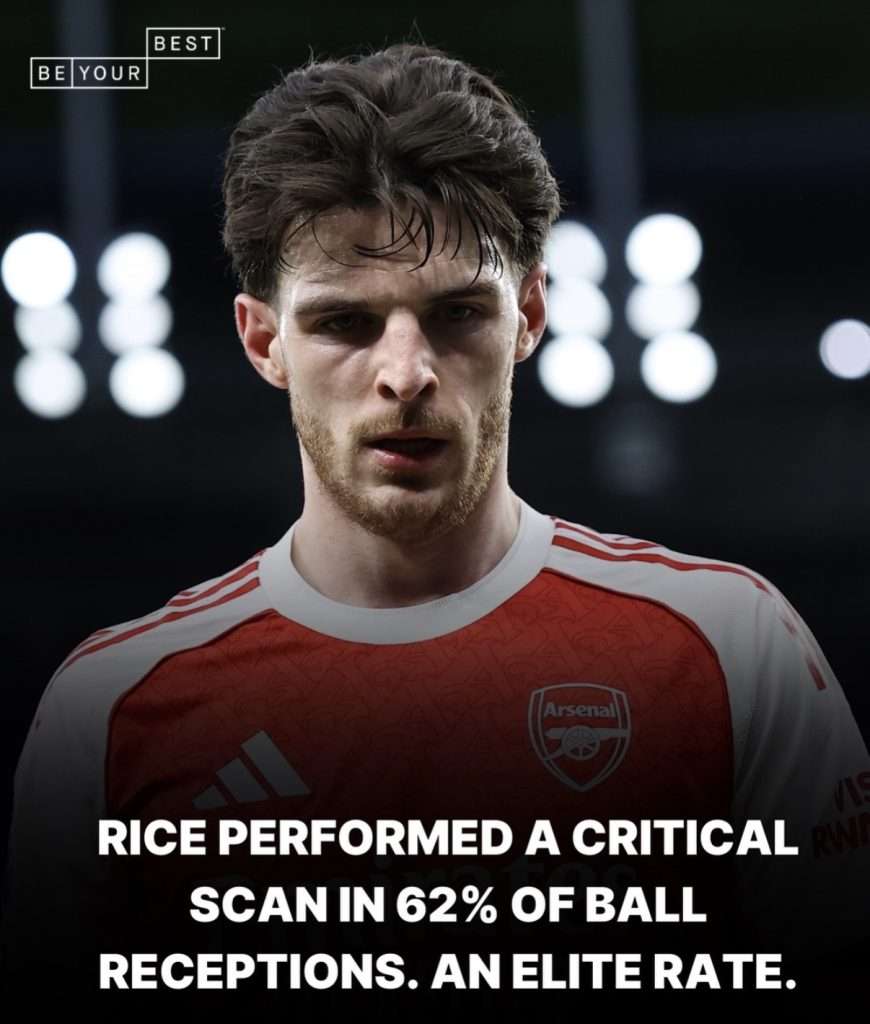
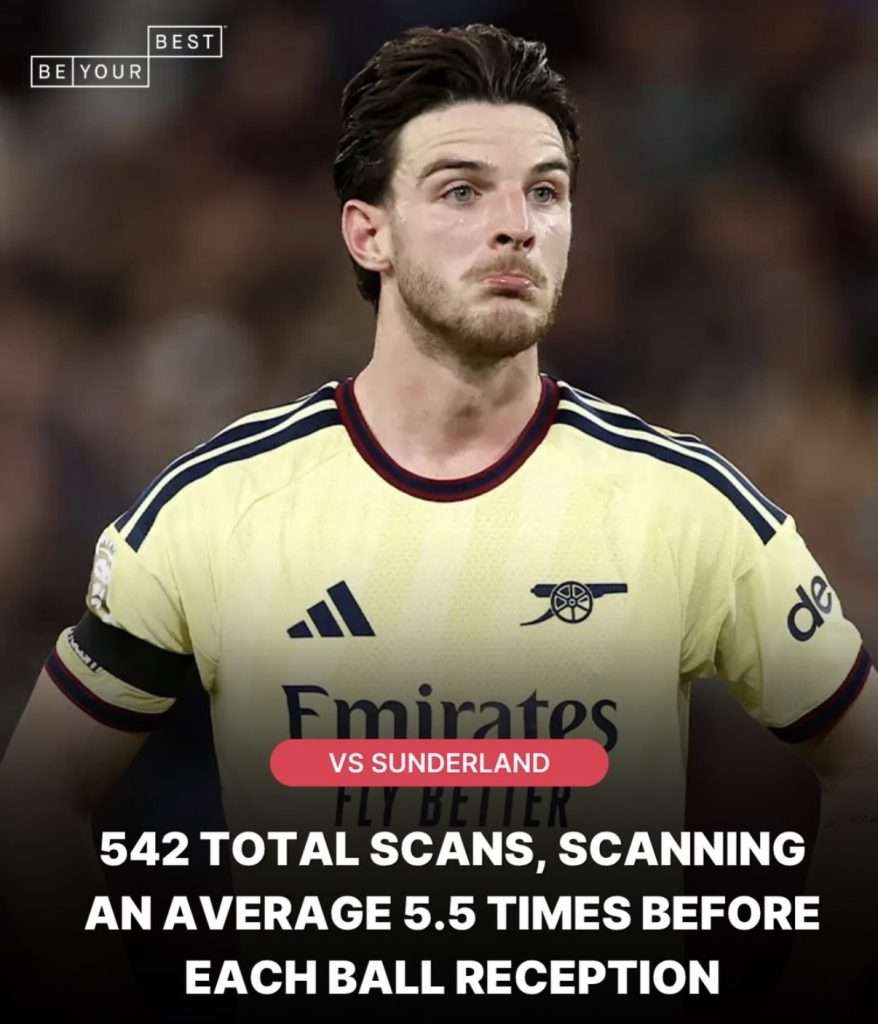
Rice vs Sunderland – Saturday, September 12
Rice made 542 scans during his 82 minutes on the pitch, across 53 receiving situations. His scan rate of 0.55 was above the Premier League average of around 0.53 for central midfielders, while 61.5% of his scans immediately before receiving the ball were classified as critical scans.
The data also showed how Rice’s scanning translated into his work on the ball. Most notably, he completed 32 of his 33 forward passes, giving him a 97% success rate when progressing the ball, with 62.3% of his passes played forward.
Arsenal went on to beat Sunderland 2-0.
Rice vs Brighton – Saturday, September 19
Rice increased his total scans at The Amex, making 598 scans during his 90 minutes on the pitch, across 38 receiving situations. His scan rate of 0.52 was just below the Premier League average of around 0.53 for central midfielders, while 68.4% of his scans immediately before receiving the ball were classified as critical scans.
Against the Seagulls, Rice’s passing was weaker as he completed only 15 of his 21 (71%) forward passes and only 55% of his total 38 passes were played forward. He passed backwards 10 times and sideways seven times in a match which Arsenal’s midfield looked out of sorts.
The home side bullied Arsenal into a 3-0 loss.
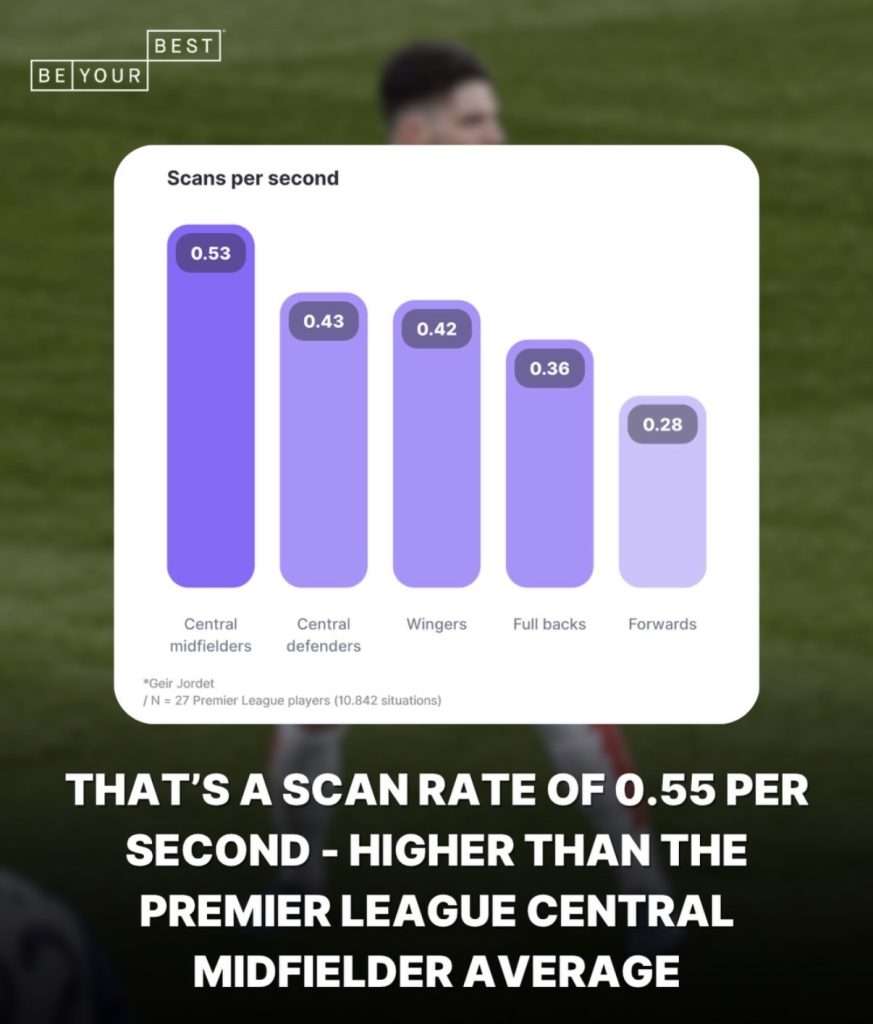
Overall, the numbers support the idea that Rice’s scanning is purposeful and his performance highlights the value of the skills Be Your Best is designed to develop, with players able to use Meta Quest VR headsets to experience immersive match scenarios and sharpen their scanning, awareness and decision-making.
A number of high profile footballers have used the Be Your Best technology, including Martin Odegaard, Endrick, Aurelien Tchouameni, Marc Guehi and Romeo Lavia, who is also an investor in the company.
Andreas Olsen, Be Your Best’s CEO, said:
“What Declan Rice’s scanning stats show is that his scanning is purposeful. He isn’t simply turning his head – he’s gathering information at useful moments and then acting on it.
“Rice’s numbers against Sunderland are a great example. He was constantly gathering information, but the important thing is what he did with it. Completing 32 of 33 forward passes shows how effectively his awareness translated into his actions on the ball. Even though his levels dropped against Brighton, we still saw the importance of scanning the field, as his total scans and critical scan rate both increased.
“At Be Your Best, we know the power of cognitive training alongside traditional football methods. Rice’s Arsenal teammate Martin Odegaard has used Be Your Best in his training, and we’re continuing to see more elite players recognise the value of cognitive training to improve their game intelligence.”
To find out more about Be Your Best’s market leading products, visit https://www.beyourbest.com/
About Be Your Best
Be Your Best is a football technology company using virtual reality and cognitive science to help players train their decision-making, scanning, and game intelligence. Since its launch, the platform has been adopted by professional clubs and players globally, as well as ambitious amateur players looking to sharpen their football IQ. By combining cutting-edge VR with elite coaching insights, Be Your Best allows users to experience the game from a player’s point of view.
Enjoyed this article? Read more from our Insight series here, or join over 3,000 sport professionals who receive our weekly newsletter here.


